
Best Travel Cameras 2026 with Flip Screen & Stabilization
Best Travel Cameras 2026 with Flip Screen & Stabilization
If you travel to create content, your camera has to do more than produce sharp images. It has to keep up with movement, unpredictable light, long days, and moments that only happen once. In 2026, travelers are no longer choosing cameras solely on megapixels. You are choosing tools that let you shoot confidently, handheld, and on the move.
That is why Travel Cameras 2026 with Flip Screen & Stabilization have become the go-to choice for modern travel creators. A flip screen lets you frame yourself accurately without guesswork. Stabilization helps smooth out walking shots, handheld clips, and spontaneous moments when a tripod is impractical or impossible.

This guide is built for aspiring and intermediate travelers who want professional-looking photos and video without carrying heavy rigs or dealing with complex setups.
You will learn what actually matters when choosing a travel camera with a flip screen and stabilization, which features make the biggest difference on real trips, and which specific models offer the strongest balance of portability, performance, and reliability in 2026.
Why Flip Screens and Stabilization Matter for Travel in 2026
Travel content has changed. You are no longer just documenting places. You are telling stories in motion. That might mean walking through a city while talking to camera, filming transitions between locations, or capturing quick reflections at the end of a long day.
A flip screen gives you control. Instead of hoping you are in frame, you can see yourself clearly, adjust composition, and maintain eye contact with the lens. This is especially important when you are filming solo and cannot rely on a second person to monitor framing.
Stabilization is equally critical. Travel rarely allows ideal shooting conditions. You are often filming while walking, standing on uneven ground, or holding a camera for long periods. In-body stabilization and advanced electronic stabilization help reduce shake, smooth motion, and make footage comfortable to watch.
Together, these features remove friction. When shooting feels easier, you shoot more. That consistency is what improves content quality over time.

What to Prioritize When Choosing Travel Cameras 2026 with Flip Screen & Stabilization
Before comparing models, focus on the features that actually affect your on-road experience.
Effective Stabilization, Not Just Marketing Claims
Not all stabilization works the same way. Some cameras rely heavily on digital correction, which can crop footage and reduce quality. Others use sensor-based stabilization that physically compensates for movement.
For travel, prioritize:
-
In-body image stabilization that works for both photo and video
-
Stabilization that remains effective while walking or panning
-
Minimal image cropping during stabilization
Strong stabilization allows you to film handheld confidently without constantly stopping to reset your shot.
Fully Articulating Flip Screens
A true flip screen should rotate fully to face forward. Tilt-only screens limit flexibility and make self-filming awkward.
Look for:
-
Fully articulating screens that face forward and fold away
-
Bright displays are visible in daylight
-
Responsive touch controls for quick focus and menu changes
A good flip screen improves framing, speeds up shooting, and reduces wasted clips.

Portability for All-Day Carry
Travel days are long. If a camera feels heavy or awkward, you will use it less.
Prioritize:
-
Lightweight bodies with balanced grips
-
Compact lenses that do not overwhelm the body
-
Comfortable handling during extended use
Portability directly affects how often you shoot, which matters more than marginal spec differences.
Reliable Autofocus for Movement
When you are moving, autofocus performance matters more than resolution.
Look for:
-
Face and eye detection that works in motion
-
Reliable subject tracking
-
Minimal focus hunting in mixed lighting
Good autofocus lets you stay present instead of constantly checking focus.

Types of Travel Cameras with Flip Screen & Stabilization
Understanding camera categories helps narrow your options quickly.
APS-C Mirrorless Travel Cameras
APS-C cameras are a popular choice for travel because they balance image quality with portability. Lenses are smaller, bodies are lighter, and performance is strong for both photo and video.
These cameras work well if you walk long distances, shoot casually between locations, or want a discreet setup.
Full-Frame Compact Mirrorless Cameras
Full-frame travel cameras offer better low-light performance and dynamic range, but can still be compact when designed thoughtfully.
They are ideal if you want premium image quality without stepping up to bulky professional rigs.
Vlogging-Friendly Hybrid Cameras
Some cameras are designed specifically for creators who shoot both photo and video. These models prioritize flip screens, stabilization, and usability over extreme specs.
They are often the easiest cameras to live with while traveling.
Best Travel Cameras 2026 with Flip Screen & Stabilization
Below are strong options that perform well in real travel conditions and support handheld shooting confidently.
Sony Alpha a7C II
Style: Full-Frame Mirrorless
Manufacturer: Sony
✅ Get Customer Reviews & Best Price
Pros
-
Compact full-frame body
-
Excellent in-body stabilization
-
Fully articulating flip screen
-
Strong autofocus for people and movement
Cons
-
Smaller grip with large lenses
-
Single card slot
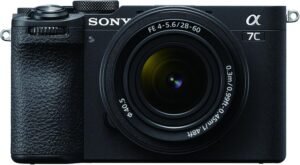
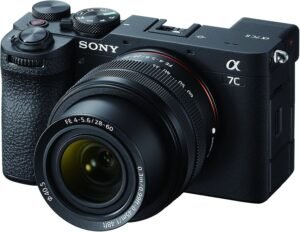
The Sony Alpha a7C II is designed for travelers who want full-frame image quality in a body that remains easy to carry all day. Its stabilization system works well for handheld video and slow walking shots, reducing the need for external gimbals in many situations.
The flip screen lets you frame yourself confidently when filming, making it well-suited for solo travel creators. Autofocus performance is reliable in motion, which is critical when you are walking, turning, or shooting in crowded environments.
This camera fits best if you want premium image quality without building a heavy kit.
For travel creators who alternate between filming themselves and capturing destinations, the a7C II offers a workflow that feels efficient rather than demanding. The compact body encourages daily carry, which matters more than peak specifications when you are moving through unfamiliar places.
Its stabilization system helps smooth handheld clips when walking slowly or repositioning between shots, reducing the need to stop and reset constantly.
The flip screen also supports quick adjustments when lighting changes unexpectedly, such as stepping from bright streets into shaded areas or from bright interiors into shaded areas. Because the camera pairs well with compact primes and short zooms, you can build a travel kit that stays lightweight without sacrificing image flexibility.
If your travel style values mobility, consistency, and dependable performance across a range of shooting scenarios, this camera integrates smoothly into real-world trips.
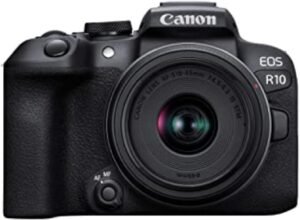
Canon EOS R10
Style: APS-C Mirrorless
Manufacturer: Canon
✅ Get Customer Reviews & Best Price
Pros
-
Lightweight and travel-friendly
-
Fully articulating flip screen
-
Reliable stabilization for handheld work
-
Simple and intuitive interface
Cons
-
APS-C sensor limits extreme low-light performance
-
Smaller battery
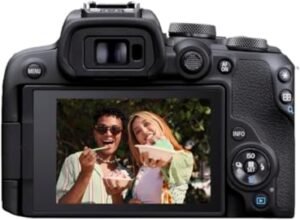
The Canon EOS R10 appeals to travelers who want speed, ease of use, and confidence without complexity. Its flip screen and stabilization make it easy to capture handheld clips, street scenes, and self-filmed segments.
Canon’s color rendering reduces editing time, which matters when you are working on the road. The camera feels approachable, allowing you to focus on storytelling rather than technical adjustments.
The EOS R10 works especially well for travelers who want a camera that feels responsive without feeling complicated. When you are navigating crowded streets, public transportation, or fast-moving environments, its lightweight body and balanced handling reduce fatigue and encourage spontaneous shooting. This matters when moments appear quickly and disappear just as fast.
The flip screen supports self-filming without awkward angles, while stabilization helps steady handheld footage during casual movement. Because the camera does not overwhelm you with settings, you can focus on timing and composition rather than menu navigation.
For travelers building confidence in both photo and video, the R10 provides a practical balance between modern features and ease of use that fits naturally into long travel days.
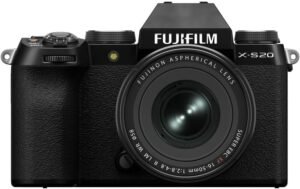
Fujifilm X-S20
Style: APS-C Mirrorless
Manufacturer: Fujifilm
✅ Get Customer Reviews & Best Price
Pros
-
Strong in-body stabilization
-
Fully articulating flip screen
-
Compact body with excellent handling
-
Good balance of photo and video performance
Cons
-
Smaller lens ecosystem than Sony
-
Menus require some learning
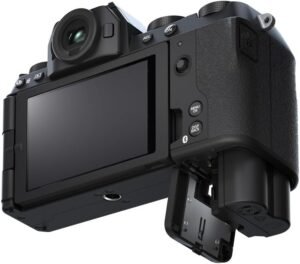
The Fujifilm X-S20 is a strong hybrid camera for travel creators who want stabilization that genuinely works while moving. Its stabilization system performs well for handheld video, while the flip screen supports confident self-filming.
The camera’s grip and control layout make it comfortable during long days, and its image quality holds up well across varied lighting conditions.
The Fujifilm X-S20 stands out for travelers who want stabilization that genuinely supports handheld storytelling. Its in-body stabilization is effective enough to smooth everyday movement, which is useful when filming short clips while walking or adjusting position. This reduces reliance on external stabilization tools and keeps your setup simple.
The camera’s flip screen helps maintain consistent framing when filming solo, and its comfortable grip supports longer shooting sessions without strain. Image files hold up well across varied lighting conditions, helping maintain a cohesive visual style throughout a trip.
If you prefer a camera that balances creative flexibility with travel practicality, the X-S20 fits well into itineraries that include both intentional photography and spontaneous video moments.
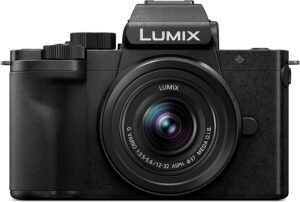
Panasonic Lumix G100 II
Style: Micro Four Thirds Mirrorless
Manufacturer: Panasonic
✅ Get Customer Reviews & Best Price
Pros
-
Lightweight and compact
-
Fully articulating flip screen
-
Good electronic stabilization
-
Designed with creators in mind
Cons
-
Smaller sensor limits low-light performance
-
Not ideal for heavy background blur
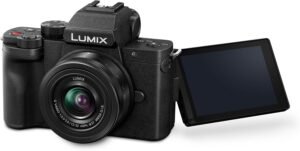
The Lumix G100 II is built for travelers who prioritize ease of use and portability. It works well for handheld filming, city walks, and casual travel storytelling. While it does not compete with larger sensors in low light, it excels in daylight and well-lit environments, which is where much travel content is captured.
The G100 II is well-suited for travelers who prioritize simplicity and portability over technical depth. Its lightweight design makes it easy to carry through cities, museums, and walking-heavy itineraries without becoming a burden. When a camera feels effortless to carry, it is more likely to be used consistently throughout the day.
The flip screen and stabilization support quick handheld filming, making it easier to capture reflections, transitions, and casual commentary while traveling. While the smaller sensor performs best in good lighting, that aligns with how much travel content is captured during daytime exploration.
For creators who want a straightforward, approachable camera that supports storytelling without demanding constant adjustments, the G100 II offers a comfortable entry point.
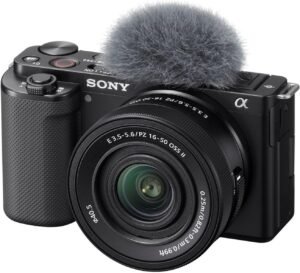
Sony ZV-E10
Style: APS-C Mirrorless
Manufacturer: Sony
✅ Get Customer Reviews & Best Price
Pros
-
Flip screen designed for creators
-
Strong stabilization for walking shots
-
Compact and lightweight
-
Excellent autofocus
Cons
-
No viewfinder
-
Limited weather sealing
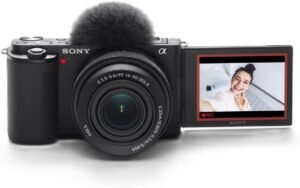
The Sony ZV-E10 remains a popular travel choice because it removes friction. The camera is easy to use, reliable in motion, and well-suited for handheld filming. It fits travelers who prioritize video but still want capable photo performance.
The ZV-E10 continues to appeal to travelers who want a camera that prioritizes speed and ease of use. Its flip screen is positioned specifically for self-filming, making it easy to monitor framing while talking to the camera or capturing quick updates during your trip.
Stabilization helps smooth handheld footage enough for casual walking shots, which covers many real-world travel scenarios.
Because the camera remains compact and lightweight, it pairs well with small lenses, keeping your kit manageable. Autofocus reliability lets you focus on delivering your message without worrying about missed focus.
If your travel content leans heavily toward video but still includes photos for social feeds or storytelling, the ZV-E10 supports that hybrid workflow with minimal friction.
Use Our Decision Tool
We created this quiz to help you select the best flip-screen camera for your needs. Just answer the 7 questions, and the tool will recommend a camera for your unique situation.
🎥 Find Your Perfect Travel Camera
Answer 6 quick questions to discover which camera with flip screen and stabilization matches your travel style
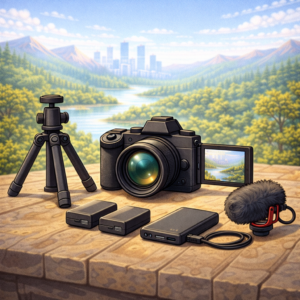
Accessories That Improve Flip Screen Travel Cameras
Accessories often improve results more than upgrading bodies.
-
Lightweight Travel Tripod for static shots and night scenes
-
Compact Shotgun or Lavalier Microphone for clearer audio
-
Spare Batteries and USB-C Power Bank for all-day shooting
These additions extend flexibility without adding much weight.
How to Choose the Right Camera for Your Travel Style
When choosing Travel Cameras 2026 with Flip Screen & Stabilization, ask yourself:
-
Do you film yourself often or mostly shoot scenes?
-
Do you prioritize portability or low-light performance?
-
Are your clips spontaneous or carefully planned?
-
How much gear do you want to carry daily?
The best camera is the one that feels easy to use every day of your trip.

Frequently Asked Questions
Do you really need a flip screen for travel?
A flip screen is not mandatory, but it dramatically improves usability if you film yourself or work solo. It reduces wasted footage and speeds up shooting.
It also helps when framing shots at unusual angles, such as overhead, low, or tight perspectives. For travelers juggling bags, movement, and timing, a flip screen simplifies decision-making and minimizes reshoots.
Is in-body stabilization better than electronic stabilization?
In-body stabilization is generally more effective for walking and handheld movement. Electronic stabilization helps, but can reduce image quality through cropping.
In-body systems preserve your full field of view and work across both photo and video modes. This consistency is valuable when switching quickly between shooting styles while traveling.
Are full-frame travel cameras worth the extra weight?
They can be if you shoot often in low light or want maximum image flexibility. Many travelers prefer APS-C for comfort and portability.
Full-frame systems reward photographers who prioritize editing latitude and subject separation, but they demand more planning around lens size, weight, and daily carry comfort.
Can you travel without a gimbal in 2026?
Yes. Modern stabilization systems often make gimbals optional for casual travel shooting.
In-body stabilization combined with controlled movement techniques covers most walking, panning, and static shots. Gimbals are still useful for dynamic motion, but they are no longer essential for everyday travel content.
Is APS-C good enough for professional-looking content?
Absolutely. APS-C cameras deliver excellent quality for social media, personal brands, and many client projects.
Smaller sensors also allow lighter lenses and longer shooting days, which often leads to better storytelling. For most travel creators, usability and consistency matter more than sensor size alone.
How important is autofocus for travel video?
Very important. Reliable autofocus reduces stress and improves consistency when filming in motion.
Travel environments are unpredictable, and manual focus slows you down. Strong autofocus keeps footage usable even when subjects move unexpectedly or when lighting conditions change rapidly.

Final Thoughts
Choosing the Best Travel Cameras 2026 with Flip Screen & Stabilization is about reducing friction. When your camera feels intuitive, lightweight, and stable in your hands, you focus on the experience rather than the gear.
Flip screens and stabilization are no longer luxury features. They are tools that help you shoot more consistently, confidently, and creatively while traveling. When your camera works with you instead of against you, better content follows naturally.
Trusted Authorities
- Study cinematography from a top trade publication at American Cinematographer articles.
- Get filmmaker news and how-to coverage from No Film School.